
Electric bikes are transforming how Canadians move—cleaner, faster, and more exciting. But when choosing your perfect ride, one fundamental question arises: Should you go with a single motor or dual motor eBike? Whether you're commuting through Toronto's traffic, tackling British Columbia's backcountry trails, or winter riding on Alberta's snowy roads, your motor configuration makes a major difference in performance, safety, and riding enjoyment.
This in-depth Canadian guide explores the crucial differences between single and dual motor eBikes across 14 key factors, comparing real-world performance in conditions unique to Canadian riders. We'll also highlight top AWD product recommendations from Burchda Canada's award-winning dual motor lineup.
What Are Single Motor E-Bikes?
Single motor eBikes are equipped with one electric motor, typically mounted either in the rear hub or as a mid-drive system. Most standard commuter and city eBikes use this configuration, as it's more affordable, lightweight, and energy-efficient—ideal for flat urban routes and casual weekend rides.
Pros of Single Motor E-Bikes:
- Lightweight design for easy handling and transport
- Simpler mechanics and controls—easier to maintain
- Lower purchase price ($900–$2,000 CAD range)
- Longer range per charge (30–60 miles / 50–100 km)
- Quiet operation with fewer moving parts
Cons of Single Motor E-Bikes:
- Less torque and limited hill-climbing power (struggles beyond 15° grades)
- Traction may suffer in wet, snowy, or off-road conditions
- Rear wheel spin is common on ice and loose gravel
- Lower payload capacity for carrying gear or passengers
What Are Dual Motor AWD E-Bikes?
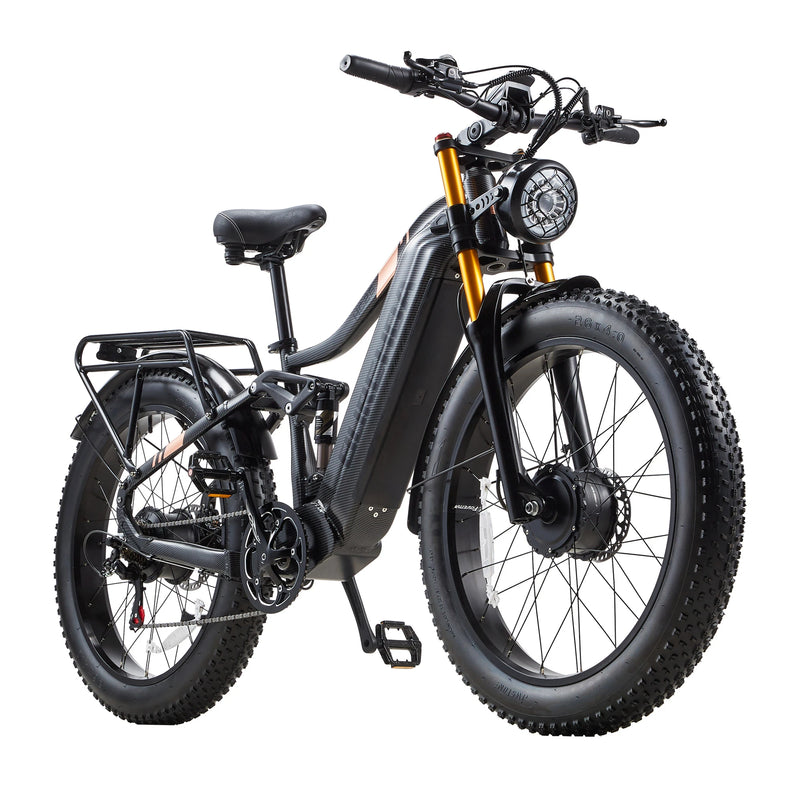
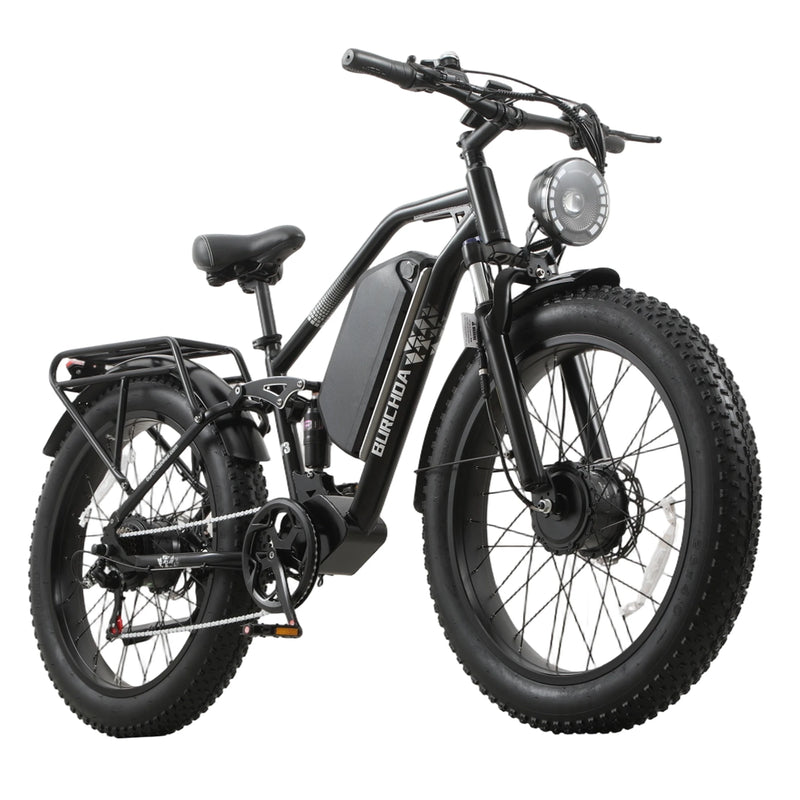
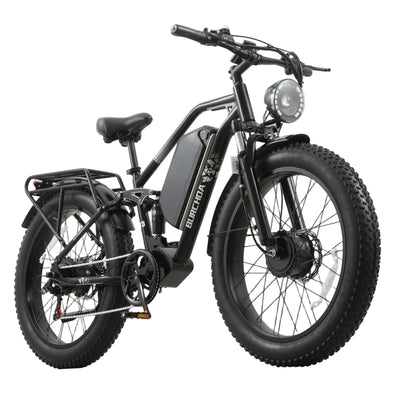
Dual motor eBikes feature two independent electric motors—one in the front hub and one in the rear. This creates an all-wheel-drive (AWD) system, providing superior traction, torque, and acceleration. Burchda Canada's AWD lineup, including the Y3 AWD and HC26 AWD, represents the cutting edge of this technology, purpose-built for Canadian conditions.
Pros of Dual Motor AWD E-Bikes:
- Maximum torque and power (2-3x more than single motor)
- Effortless climbing of steep hills and rugged terrain (35°+ grades)
- Enhanced grip in snow, sand, mud, and rain—critical for Canadian winters
- Often equipped with advanced suspension and fat tires
- Higher payload capacity (up to 227 kg / 500 lbs on Burchda Y3 AWD)
- Redundancy: if one motor fails, the other gets you home
Cons of Dual Motor AWD E-Bikes:
- Heavier build (80–100+ lbs vs 55–75 lbs for single motor)
- Higher battery consumption when running both motors
- More expensive initial investment ($1,500–$4,000+ CAD)
- Slightly more complex maintenance requirements
- High-power models may need registration in some provinces
Head-to-Head Comparison: 14 Key Factors for Canadian Riders
1. Power Output: The Torque Difference
When it comes to raw power, dual motor eBikes clearly lead the pack. A single motor typically caps at 500W to 750W, while a dual motor setup like Burchda's AWD system can offer a combined 2,000W to 5,000W or more. This translates to a massive difference in torque—critical for Canadian hills and cargo hauling.
| Configuration | Total Power | Torque | Ideal Canadian Use |
|---|---|---|---|
| Single Motor | 500W–750W | 50–80 Nm (Moderate) | Flat commutes, casual rides, Vancouver seawall |
| Dual Motor (Entry) | 1,000W–1,500W | 100–130 Nm (High) | Suburban riding, light trails, Ottawa paths |
| Dual Motor (Premium) | 2,000W–5,000W | 150+ Nm (Maximum) | Rocky Mountain trails, winter riding, heavy cargo |
Featured: Burchda Y3 AWD — 5,000W Peak Dual Motor Power

The Burchda Y3 AWD delivers dual 1500W motors (5,000W total peak power) with 150+ Nm of torque, making it one of the most powerful dual motor e-bikes on the Canadian market. Whether you're climbing the Rockies or hauling camping gear to Algonquin Park, this AWD powerhouse handles it with ease.
2. Terrain Performance: Canadian Landscape Test
Canada's terrain is incredibly diverse—from sandy PEI beaches to rocky Kootenay trails to snowy Alberta mountain passes. Your motor configuration directly determines where you can ride confidently.
| Terrain Type | Single Motor Performance | Dual Motor AWD Performance |
|---|---|---|
| Steep Hills (20°+) | Struggles, motor overheats on long climbs | Effortless climbing with balanced power delivery |
| Snow & Ice | Rear wheel spins, dangerous slips | All-wheel grip, stable acceleration in winter |
| Loose Gravel/Sand | Wheel washout, poor traction | Front and rear motors maintain grip |
| Mud & Forest Trails | Limited control, gets stuck easily | Superior traction on muddy Canadian backroads |
| Wet Pavement | Decent performance with quality tires | Enhanced stability in Vancouver rain |
3. Top Speed Potential
Though speed depends on battery voltage and motor capacity, dual motor eBikes often unlock higher top speeds due to combined motor thrust. It's important to note that Canadian e-bike laws regulate maximum speeds for Class 1, 2, and 3 categories.
| Motor Setup | Typical Top Speed | Canadian Legal Class |
|---|---|---|
| Single Motor (500W) | 20–25 mph (32–40 km/h) | Class 1 / Class 2 |
| Single Motor (750W) | 25–28 mph (40–45 km/h) | Class 3 (may require license) |
| Dual Motor (2 x 750W) | 28–35 mph (45–56 km/h) | Exceeds Class 3, check local laws |
| Dual Motor (2 x 2500W) | 35–40+ mph (56–64+ km/h) | Requires registration in most provinces |
4. Battery Consumption & Efficiency
Two motors pull more power. A dual motor eBike drains the battery faster than a single motor model—unless it's equipped with a high-capacity battery like those found on Burchda AWD models. The good news is that many dual motor bikes let you toggle one motor off to conserve energy during flat-road cruising.
| Setup | Average Range Per Charge | typical Battery |
|---|---|---|
| Single Motor (Standard) | 30–60 miles (50–100 km) | 36V 10Ah – 48V 15Ah |
| Dual Motor (Standard Battery) | 20–40 miles (32–64 km) | 48V 20Ah |
| Dual Motor (High-Capacity) | 50–80 miles (80–130 km) | 48V 30Ah – 52V 30Ah |
5. Weight & Portability
Dual motor bikes are generally heavier due to the additional motor, reinforced frame, and often dual battery systems. This impacts portability and handling in tight urban spaces like Montreal's narrow streets or Vancouver's apartment building hallways.
| Setup | Typical Weight | Portability |
|---|---|---|
| Single Motor (Commuter) | 45–50 lbs (20–23 kg) | Easy to carry upstairs or onto transit |
| Single Motor (Fat Tire) | 50–55 lbs (23–25 kg) | Moderate portability |
| Dual Motor (Fat Tire AWD) | 60–80 lbs (27–36 kg) | Heavier, consider folding AWD models |
| Dual Motor (Heavy-Duty) | 80–100+ lbs (36–45+ kg) | Best for stationary use or car camping |
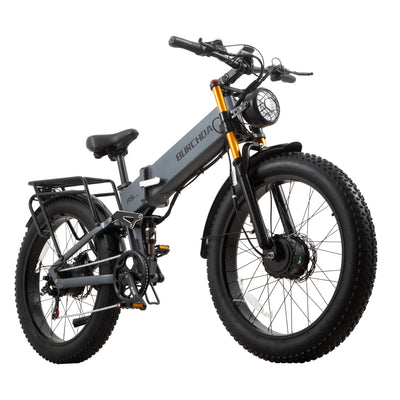
Best Folding Dual Motor: Burchda R5 AWD

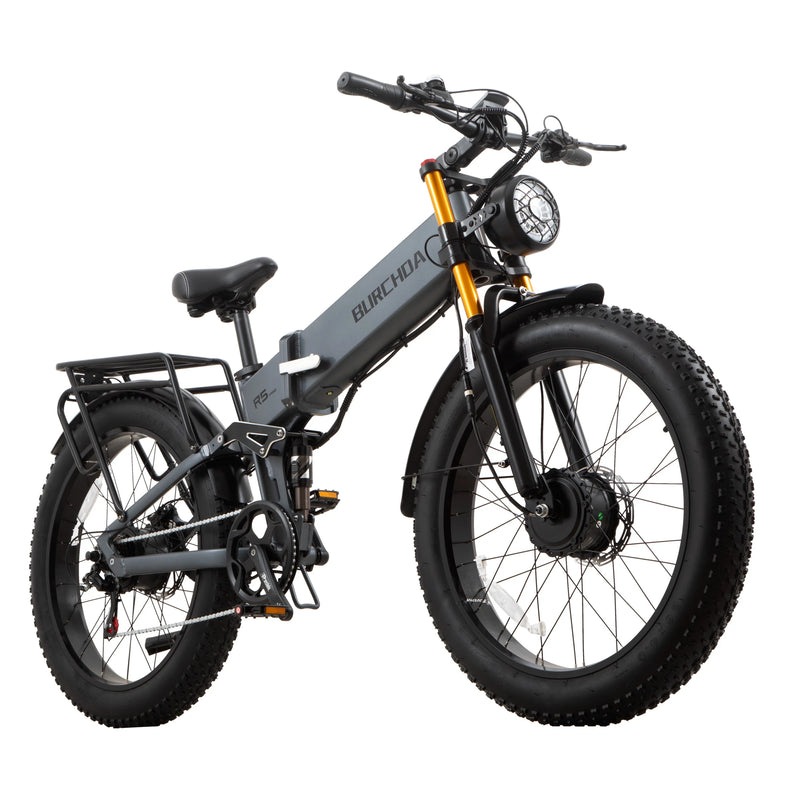
The Burchda R5 AWD folding dual motor e-bike solves the weight/portability problem. It folds compactly for easy storage in apartment closets, car trunks, or on public transit—perfect for Toronto and Vancouver commuters who need to combine cycling with transit.
6. Price & Value: Canadian Cost Analysis
Expect to pay $500–$1,000 CAD more for a dual motor setup of comparable quality. But the added investment often brings enhanced suspension, better build quality, more powerful batteries, and advanced motor control systems—features that matter in Canadian conditions.
| Setup | Price Range (CAD) | What You Get |
|---|---|---|
| Single Motor (Entry-Level) | $900 – $1,200 | Basic commuter, 500W motor, 36V battery |
| Single Motor (Premium) | $1,500 – $2,000 | Mid-drive, hydraulic brakes, better components |
| Dual Motor (Entry AWD) | $1,500 – $2,200 | 2 x 750W motors, fat tires, basic AWD |
| Dual Motor (Premium AWD) | $2,500 – $4,000+ | 2 x 2500W motors, large battery, full suspension |
Best Value Dual Motor: Burchda HC26 AWD

The Burchda HC26 AWD offers premium dual motor performance at an accessible price point. With dual 1000W motors (3000W total peak power), a 48V 30Ah battery (130+ km range), and full front suspension, it's the best value AWD e-bike for Canadian trail riders on a budget. Includes free Canada-wide shipping and a 2-year warranty.
7. Safety in Canadian Conditions
Safety is paramount, especially in Canada's unpredictable weather. Here's how the two configurations compare:
| Safety Factor | Single Motor | Dual Motor AWD |
|---|---|---|
| Winter Traction | High risk of sliding on ice/snow | Confident all-wheel grip in winter conditions |
| Wet Roads | Rear wheel slip in heavy rain | Balanced power prevents hydroplaning |
| Emergency Stopping | Standard stopping distance | Hydraulic disc brakes + AWD = shorter stops |
| Night Riding | Dependent on external lights | Many models include integrated LED headlights |
8. Maintenance & Durability
Both configurations require regular maintenance, but the complexity differs:
| Factor | Single Motor | Dual Motor AWD |
|---|---|---|
| Maintenance Frequency | Monthly checks, annual service | Monthly checks, bi-annual service recommended |
| Motor Complexity | 1 motor, simpler wiring | 2 motors, controller system, more wiring |
| Durability | Proven technology, widely supported | Heavy-duty components for rugged Canadian use |
| Warranty | 1–2 years typical | Burchda offers 2-year warranty on all AWD models |
9. Commuting vs. Off-Road: Use Case Comparison
| Riding Scenario | Single Motor | Dual Motor AWD |
|---|---|---|
| Urban Commute (Toronto, Vancouver) | ✓ Ideal for flat city routes | ✓ Overkill but safe in rain/snow |
| Suburban Hills (Ottawa, Calgary) | △ May struggle on steep grades | ✓ Effortless hill climbing |
| Mountain Trails (Banff, Whistler) | ✗ Not suitable for serious trails | ✓ Perfect for challenging terrain |
| Winter Riding (Saskatoon, Regina) | ✗ Dangerous on ice and snow | ✓ AWD provides critical winter safety |
| Cargo/Touring (Trans-Canada Trail) | △ Limited payload and range | ✓ Heavy-duty hauling with extended range |
| Beach Riding (PEI, Vancouver Island) | ✗ Wheels sink in sand | ✓ Fat tires + AWD = effortless beach riding |
10. Resale Value & Long-Term Investment
Dual motor AWD e-bikes generally retain their value better than single motor models, especially in Canada where rugged conditions demand higher-performance equipment. The premium brand appeal of Burchda, combined with the proven durability of its AWD lineup, means your investment holds up better over time.
11. Battery Life & Replacement Cost
Battery technology is the most critical component for long-term value. Here's how the two configurations compare:
| Factor | Single Motor | Dual Motor (Burchda) |
|---|---|---|
| Battery Life | 500–800 charge cycles | 800–1000+ charge cycles |
| Replacement Cost | $300 – $500 CAD | $600 – $900 CAD (larger capacity) |
| Charging Time | 3–5 hours | 6–10 hours (large capacity) |
12. Rider Experience & Comfort
The riding experience differs significantly between the two configurations:
Single Motor Experience:
- Smooth, quiet acceleration suitable for urban areas
- Natural feeling weight distribution
- Easy maneuverability in tight spaces
- Less vibration from fewer moving parts
Dual Motor AWD Experience:
- Thrilling "push-pull" acceleration—like a 4×4
- Confident stability in ALL conditions
- Smooth power delivery on rough terrain
- The satisfaction of conquering any hill without breaking a sweat
13. Environmental Impact & Efficiency
Both configurations are eco-friendly alternatives to cars, but there are efficiency differences:
- Single Motor: More energy-efficient per km, lower battery production impact
- Dual Motor: Higher total energy but offset by larger, longer-lasting batteries.
14. Warranty & After-Sales Support
When investing in an e-bike, especially a dual motor AWD model, after-sales support matters:
| Support Factor | Single Motor (Generic) | Dual Motor (Burchda Canada) |
|---|---|---|
| Motor Warranty | 1 year (industry standard) | 2 years (comprehensive AWD coverage) |
| Battery Warranty | 1 year | 1 years |
| Frame Warranty | 1–2 years | 2 years |
| Canada-Wide Support | Limited or none | Free shipping, 30-day trial |
Which Is Right for You? Canadian Buyer's Decision Guide
- You primarily commute on flat roads (e.g., Vancouver seawall, Toronto waterfront)
- Budget is a concern ($900–$2,000 CAD)
- You value lightweight and portability (apartment living, transit)
- You want minimal maintenance and simple mechanics
- You ride mostly in mild weather conditions
- You tackle steep hills or off-road trails (Rockies, Laurentians, Bruce Peninsula)
- You ride in challenging weather—snow, sand, mud, or heavy rain
- You need to carry heavy loads (camping, groceries, passenger)
- You crave maximum power and acceleration
- You want year-round riding capability in Canadian winters
- You're investing in a long-term, versatile outdoor companion
Ready to Upgrade to Dual Motor AWD?
Burchda Canada offers free shipping across Canada, a 30-day home trial, and a 2-year warranty on all AWD e-bikes. Join thousands of Canadian riders who've made the switch to all-wheel drive freedom.
Top Burchda AWD Dual Motor E-Bikes for Canadian Riders
🏆 Burchda Y3 AWD — Best Overall for Canadian Conditions

Key Specs:
- Dual 1500W motors (5,000W total peak power)
- 52V 30Ah battery (130+ km / 80 miles range)
- Top speed: 64 km/h (40 mph)
- Payload capacity: 227 kg (500 lbs)
- 26" x 4.0" fat tires for all-terrain grip
- Hydraulic disc brakes for reliable stopping in all weather
Why Canadian riders love it: The Y3 AWD's massive dual motor system conquers Rocky Mountain passes, handles Toronto's potholes with ease, and cruises through Quebec's winter snow. With a Class 3 compliant mode for road use and full-power off-road capability, it's the most versatile dual motor ebike on the Canadian market.
🚵 Burchda HC26 AWD — Best Value for Trail Riding

Key Specs:
- Dual 1000W motors (3,000W total peak power)
- 48V 30Ah battery (130+ km / 80 miles range)
- Top speed: 48 km/h (30 mph)
- Full front suspension for rough trails
- Hydraulic disc brakes for reliable stopping power
Perfect for: Riders in Ontario's Bruce Peninsula, BC's Gulf Islands, or Alberta's Kananaskis Country who want serious off-road capability without the premium price tag. The HC26 AWD strikes the ideal balance of power, comfort, and affordability for Canadian trail enthusiasts.
🎒 Burchda R5 AWD — Best Folding Dual Motor

Key Specs:
- Dual 1500W motors (5,000W total peak power)
- Folding frame for easy storage and transport
- 48V 30Ah battery (130+ km / 80 miles range)
- Top speed: 64 km/h (40 mph)
- Fat tires with all-terrain capability
- Hydraulic disc brakes for reliable stopping power
Ideal for: Apartment dwellers in Montreal who need to carry their bike upstairs, Vancouver commuters who take the SeaBus, or anyone who wants dual motor performance with the convenience of a folding bike. The R5 AWD is a game-changer for urban Canadian riders.
Frequently Asked Questions
Are dual motor electric bikes worth the investment in Canada?
Yes—for most Canadian riders. Dual motor e-bikes are worth the premium for anyone who faces winter snow, steep hills, or off-road trails. The AWD system provides critical traction and safety that single motor bikes cannot match. If you only ride on flat, paved roads in mild weather, a single motor may be sufficient. But for the majority of Canadian riders who encounter diverse conditions, dual motor is the safer, more capable choice.
What is the price difference between single motor and dual motor ebikes in Canada?
In Canada, single motor ebikes typically range from $900 to $2,000 CAD, while dual motor AWD models range from $1,500 to $4,000+ CAD. The Burchda Ebike starts at $2,099, offering premium dual motor performance at a competitive price. The $500–$1,000 premium over single motor is justified by the added traction, safety, and capability.
Can dual motor ebikes handle Canadian winter conditions?
Absolutely. Dual motor AWD ebikes are ideal for Canadian winter riding. The all-wheel drive system prevents slipping on ice and snow, and the fat tires provide additional floatation on soft snow. Models like the Burchda Y3 AWD are specifically tested and engineered for Canadian winter conditions. Just remember to keep your battery warm and check tire pressure regularly in cold weather.
Are dual motor electric bikes legal in all Canadian provinces?
Yes, dual motor e-bikes are legal across Canada, but regulations differ by province. Class 1 and 2 bikes (max 750W, 32 km/h) are treated as regular bicycles everywhere. High-power dual motor models exceeding these limits may be classified as motor vehicles in BC, Ontario, and Quebec, requiring registration, insurance, and a driver's license. Always verify local rules before riding.
How much more torque do dual motor ebikes produce?
Dual motor ebikes typically deliver 2-3x more torque than single motor models. A single motor might produce 50-80 Nm, while Burchda's AWD lineup delivers 150+ Nm of combined torque. This extra torque is critical for effortless hill climbing, carrying heavy cargo, and maintaining control on loose or slippery terrain.
Do dual motor ebikes require special maintenance in Canada?
Yes, dual motor ebikes need slightly more maintenance than single motor models due to the additional motor and more complex electrical system. We recommend monthly checks of tire pressure, brake condition, and battery health, plus annual professional servicing.
Final Verdict for Canadian Riders
There's no one-size-fits-all answer, but the data is clear: for the majority of Canadian riders who face diverse terrain, variable weather, and challenging conditions, a dual motor AWD e-bike is the superior choice. The combination of all-wheel traction, powerful torque, and proven durability makes AWD models like the Burchda Y3 AWD and HC26 AWD ideal for everything from urban commuting to backcountry adventures.
Single motor bikes still have their place—they're more affordable, lighter, and sufficient for flat, mild-weather riding. But if you want the freedom to ride anywhere in Canada, in any season, a dual motor AWD e-bike is the investment that pays dividends in safety, capability, and riding enjoyment.
Experience the Burchda AWD Difference
Join thousands of Canadian riders who've discovered the power, safety, and freedom of dual motor AWD e-bikes. Burchda Canada offers free shipping, a 30-day home trial, and a 2-year warranty on all models.