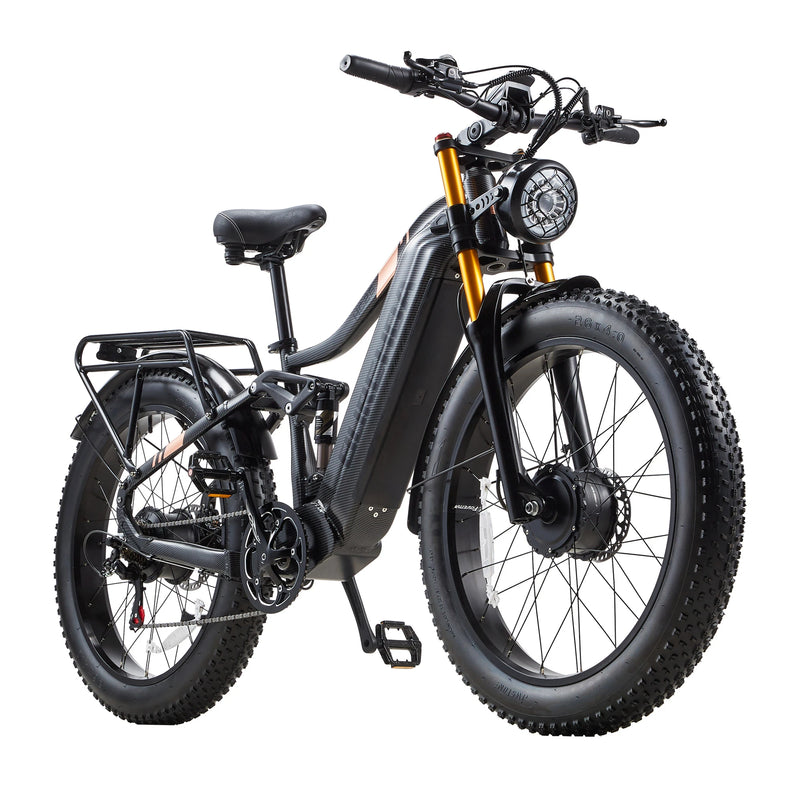

As hunting season 2026 heats up across Canada — from BC's Rocky Mountain elk to Ontario's white-tailed deer and Saskatchewan's whitetail zones — one question keeps coming up in hunting camps and online forums: Should I trade my ATV for an electric bike?
We sell dual motor hunting e-bikes here at Burchda Canada, so we're going to be completely upfront: an e-bike does not replace an ATV in every scenario. But it does replace an ATV in many Canadian hunting scenarios — and saves you thousands of dollars, hours of trailer hassle, and your hunting spot from being spooked before you even get there.
This is an honest, data-driven comparison based on real Canadian prices, real provincial regulations, and real feedback from hunters who have used both.
The Short Answer
An electric hunting bike is quieter, cheaper, lighter, and legal in more Canadian hunting areas than an ATV. An ATV has more raw hauling power, longer range, and handles extreme terrain that would stop even the best e-bike cold. The right choice depends on where you hunt, what you hunt, and what you need to haul out.
Noise: The Single Biggest Difference
This is not close. It is the reason 8 out of 10 hunters who switch to an e-bike never go back to hunting with an ATV. The numbers speak for themselves:
| Vehicle | Noise Level | Audible Distance in Quiet Woods |
|---|---|---|
| ATV at cruising speed | 90–100 dB | 1/4 to 1 mile |
| ATV at idle | 75–85 dB | Several hundred yards |
| Electric hunting bike | 20–35 dB (motor hum + tire noise) | 50–150 feet |
| Normal conversation | 60 dB | — |
| Quiet Canadian forest | 20–30 dB | — |
An ATV announces your presence to every whitetail deer within a quarter mile. An e-bike is effectively inaudible beyond 50 yards. For reference: every 10 dB roughly doubles perceived loudness. An ATV is 30–60 times louder than an e-bike to the animals you are hunting.
An Alberta bowhunter shared on a Canadian hunting forum: "I had two choices — ATV and all the noise, or walk and get sweaty, tired, and spread my scent all over the place. With my dual motor e-bike, I was able to access the stand, stay downwind, silently. I tagged out on day 1 — something I haven't done in three seasons of ATV hunting."
A BC elk hunter put it even more plainly: "I can't really hunt without the e-bike anymore. It's quiet, it's stealthy, and I can ride to the stand and dump it in the weeds without spooking anything. My old ATV sits in the garage collecting dust except for one weekend a year."
One Counterpoint Worth Noting
A BC Parks and Wildlife field officer reported that e-bikes may still alert game in some situations — not because of volume, but because the high-pitched motor frequency is unfamiliar to wildlife. This is an outlier opinion but worth considering. Hub-motor bikes (like Burchda's dual motor AWD system) are quieter than mid-drives if stealth is your absolute top priority.
Cost: It Is Not Even Close (Especially in Canada)
Purchase Price Comparison (CAD)
| Vehicle | Typical Price Range (CAD) |
|---|---|
| ATV 400–450cc Class | $9,000 – $11,000 |
| ATV 570–650cc Class | $14,500 – $18,000 |
| ATV 850–1000cc Class | $17,500 – $22,000 |
| UTV 2-Seat 1000cc Class | $18,000 – $24,000 |
| UTV 4-Seat / Heavy-Duty Class | $27,000 – $35,000 |
| Burchda Y3 AWD (5000W Peak Dual Motor) | $1,999 |
| Burchda HC26 AWD (3000W Peak Dual Motor) | $1,999 |
| Burchda R5 AWD Folding (5000W Peak) | $1,999 / Camo $2,199 |
A capable dual motor AWD e-bike like the Y3 at just $1,999 is $12,500 cheaper than a brand new mid-range ATV (Polaris Sportsman 570 = $14,589 CA 2026 MSRP) — and even costs less than many used ATVs on Kijiji. And remember: Canadian ATV prices are 30–40% higher than US prices due to import duties, GST, and PDI fees.
5-Year Total Cost of Ownership (CAD)
| Cost Category | ATV (5 years) | Hunting eBike (5 years) |
|---|---|---|
| Purchase price | $14,500 – $35,000 | $1,999 – $2,199 |
| Fuel / electricity (5 yrs) | $7,500 – $15,000 (AVG $1.86/L × 120–200 L/year hunting use) | $150 – $380 (40–100 charges/year × 1.66 kWh @ province rate × 5 yrs) |
| Maintenance (5 yrs) | $7,500 – $15,000 | $500 – $1,000 |
| Insurance (5 yrs) | $1,500 – $5,000 | $0 – $300 (optional) |
| Registration (5 yrs) | $500 – $1,750 | $0 |
| Trailer / transport | $1,500 – $4,000 | $0 – $200 (hitch rack) |
| 5-Year Total | $33,000 – $75,750 | $2,650 – $4,100 |
The ATV's hidden costs add up fast. Oil changes, air filters, CVT belts, tires, insurance, registration, and — the one most Canadian hunters forget — the trailer. A single-ATV trailer runs $1,000–$3,000. You also need a tow-capable vehicle and you burn 20–30% more fuel towing it through the Canadian wilderness.
A hunting e-bike fits in a truck bed or on a $200 hitch rack. No trailer, no registration, no insurance requirement — and electricity costs $0.14–$0.41 per full charge, depending on your province's all-in residential rate (including delivery & transmission). Here's how it breaks down for Burchda AWD models (48V 30Ah / 52V 30Ah = ~1.66–1.79 kWh actual consumption with 15% charging losses):
| Province | 2026 All-In Rate | Burchda HC26/R5 (1.66 kWh) | Burchda Y3 (1.79 kWh) |
|---|---|---|---|
| Quebec | $0.083/kWh | 14¢ | 15¢ |
| Manitoba | $0.106/kWh | 18¢ | 19¢ |
| British Columbia | $0.110/kWh | 18¢ | 20¢ |
| Ontario (blended) | $0.170/kWh | 28¢ | 30¢ |
| Saskatchewan | $0.186/kWh | 31¢ | 33¢ |
| Alberta | $0.229/kWh | 38¢ | 41¢ |
Compare that to an ATV: a typical 38–45L ATV tank costs $70–$83 CAD to fill at the 2026 Canadian average of $1.86/L (NRCan September 2026 data, all taxes included). You need a full tank every 80–100 km of forest riding. Over a year of 20–40 hunting trips, that's $1,500–$3,000 in gasoline alone. Now compare that to Burchda AWD: a 130 km equivalent range charge costs $0.18–$0.41 in electricity depending on your province — and even an active hunter logging 60+ trips a year only pays $25–$150 total in electricity for a full season of hunting.
Regulation: Where You Can (and Cannot) Ride in Canada
This is where e-bikes have a regulatory advantage that surprises most Canadian hunters. Unlike the US system, Canadian provinces generally treat Class 1 e-bikes (500W max, 32 km/h, pedal-assist only) as regular bicycles — meaning they're allowed on trails where ATVs and UTVs are banned entirely.
Canadian Province-by-Province Access (2026)
| Province | eBike Access | ATV Access |
|---|---|---|
| British Columbia | ⚠️ Complex. Standard e-bike: 500W continuous / 32km/h. But Wildlife Act MVP regulations classify e-bikes as motor vehicles for hunting — many Crown land hunting areas explicitly ban e-bikes. Check MVP maps before riding. | Restricted to designated motorized vehicle routes. Same MVP ban applies. |
| Alberta | Power bicycles: 500W / 32km/h. Class 1 allowed on Forest Service roads and multi-use trails. Banff/Jasper: pedal-assist only on designated trails. | Restricted to designated motorized trails and roads. |
| Ontario | PAB: 500W / 32km/h. Allowed on Crown land trails where bicycles are permitted. Ontario Reg 369/09 sets vehicle weight limits of 120kg. | Restricted to designated ATV trails. No access to Algonquin Park backcountry. |
| Saskatchewan | Treated as power bicycles under provincial law. Very open access on Crown land. 500W / 32km/h recommended. | Restricted to designated motorized trails. |
| Manitoba | Allowed on Crown land and most provincial park trails. Follow federal PAB 500W / 32km/h guidelines. | Restricted to designated motorized vehicle routes only. |
| Quebec | PAB: 500W / 32km/h. Allowed on multi-use trails. SAAQ requires helmet for all riders, minimum age 14–16 depending on configuration. | Restricted to designated ATV trails with permits required in some areas. |
BC Warning (MVP Regulations): British Columbia's Wildlife Act explicitly classifies electric bicycles as motor vehicles under its Motor Vehicle Prohibition (MVP) regulations. Many hunting areas in BC Crown land are designated "Motor Vehicle Prohibited" — which includes e-bikes regardless of motor power. Always check the official BC Wildlife Act MVP maps before riding (link in our disclaimer below).
Where an ATV Still Wins (Be Honest About This)
We are not going to pretend otherwise. There are situations where an ATV or UTV is simply the better tool for Canadian hunting.
Hauling Capacity
| Category | Hunting eBike | ATV | UTV |
|---|---|---|---|
| Rack / cargo capacity | 80–227 lbs (Burchda Y3: 500 lbs) | 200–400 lbs | 500–1,000 lbs |
| Towing capacity | 200–500 lbs (with cart) | 1,000–1,500 lbs | 2,000–2,500 lbs |
A dual motor e-bike like the Burchda Y3 AWD with a game cart can haul a quartered whitetail deer or even a moose quarter on moderate terrain. An ATV can drag a whole deer on a sled up a steep canyon. For massive bull elk or full moose pack-outs, the difference is significant.
A veteran Rokslide hunter from Alberta put it this way: "A UTV is more handy for all-purpose use, while e-bikes are more specific in their uses. You'd either have to pull a trailer or carry a loaded pack depending on the type of hunting you are doing. That said, my dual motor e-bike replaced my ATV for 7 out of 10 hunts."
Range
| Category | Dual Motor eBike | ATV |
|---|---|---|
| Typical range | 65–130 km (40–80 miles) | 120–240 km (75–150 miles) |
| Extended range | 160–210 km (100–130 miles) with dual battery | 240+ km (150+ miles) with extra fuel |
| Refuel/recharge time | 4–8 hours (charge at camp) | 2 minutes (pour gas) |
In real Canadian hunting conditions — cold mornings (-10°C), constant climbing, and heavy gear — the effective range can drop by 20–30%. Your weight, the gear you're carrying, the steepness of terrain, and how much you rely on throttle versus pedal assist all matter. Always bring a portable charger or a second battery for remote hunts.
Extreme Canadian Terrain
Deep mud, 18+ inch water crossings, knee-deep snow, steep rocky grades with a loaded trailer — these are still ATV territory. An e-bike weighs 70–90 lbs. An ATV weighs 600–800 lbs. That weight difference means the ATV can push through conditions that would stop or tip even the best dual motor e-bike.
That said, a dual motor AWD e-bike handles Canadian conditions far better than a single motor model. The Burchda Y3 AWD's all-wheel drive pulls you through mud and snow that would bog down a regular ebike. The 26" × 4.0" fat tires distribute weight across soft terrain just like an ATV.
Where an eBike WINS Every Single Time
1. Stealth Approach
This is the reason most Canadian hunters switch. You cannot sneak to a treestand on an ATV. You can on an e-bike.
Research published in the Journal of Wildlife Management shows motorized vehicle noise causes flight responses in elk and deer at distances of 500 meters or more. Bicycle and e-bike disturbance distances are typically 50–100 meters — comparable to a person quietly walking through the woods.
A Crossbow Nation member who's hunted Alberta's Rockies for 15 years said: "Going electric has more than doubled my hunting success versus other members using ATVs and UTVs. They still laugh at my 'electric contraption' — but the proof's on the wall. I filled my elk tag on September 10th this year."
2. Scent Control
An overlooked advantage. Riding an e-bike to your stand produces far less sweat than walking — especially during early season (August–September) when temperatures are high. Less sweat means less scent on your clothing. And you're not leaving a gasoline or exhaust scent trail behind you.
3. Speed and Efficiency
An Ontario whitetail hunter reported: "What used to take 45 minutes to reach my stand now takes 15 minutes with my HC26 AWD. That extra 30 minutes means I'm in the stand and settled before sunrise — instead of sweating through my jacket and leaving scent all over the trail."
Another from Saskatchewan: "Pulling deer out has been a godsend. With my Y3 AWD and a cart, I've packed out three deer in one day that previously would have taken two full days of backpacking."
4. Accessibility for Aging Hunters
A 72-year-old hunter from BC's Okanagan Valley shared: "At 72 with bad asthma and two total knee replacements, I can use my e-bike to get around. I tried last season without it and only made it 3 km into the woods before I had to turn back. With my HC26, I ride 15 km in and hunt until dark. This bike extended my hunting career by years."
5. Transport Simplicity
A hunting e-bike weighs 65–90 lbs. It slides into a truck bed or mounts on a $200 hitch rack. No trailer to hook up, no ramps to deploy, no extra fuel cans to fill up at -30°C.
An ATV requires a trailer ($1,000–$3,000+), a tow-capable vehicle, trailer registration, and 20–30% more fuel while towing. When you factor in the time and hassle of trailering, an e-bike gets you hunting faster — and hunting is the reason you bought a vehicle for the woods in the first place.
6. Environmental Impact
An ATV at 600–800 lbs exerts 5–8 PSI on the ground. A fat-tire dual motor e-bike with rider totals ~250 lbs and exerts 2–4 PSI. The trail damage difference is significant — and it's one reason Canadian land managers increasingly allow e-bikes where ATVs are restricted.
Zero emissions, minimal trail erosion, no fluid contamination risk from oil or gas leaks. As public land access debates continue in BC, Alberta, and Ontario, e-bikes consistently get the favorable regulatory treatment.
Hunters Who Made the Switch
These are real comments from Canadian hunting forums:
The Smart Play: Use Both
Many experienced hunters don't choose one or the other — they use each tool for what it does best.
Hunters across Canada describe the combined strategy: ride the e-bike in quietly to hunt, and bring the ATV or UTV for retrieval after a successful shot. The e-bike gets you to the stand without blowing the spot. The ATV gets the animal out.
If you already own an ATV, adding a hunting e-bike to your arsenal for $1,999 – $2,199 is not replacing the ATV — it's adding a stealth tool that the ATV cannot be. You wouldn't use a rifle where a bow is the better tool. Same logic.
Complete Side-by-Side Comparison
| Category | Dual Motor eBike | ATV | Winner |
|---|---|---|---|
| Purchase price (CAD) | $1,999 – $2,199 | $9,000 – $35,000 | ✅ eBike |
| 5-year total cost | $2,650 – $4,100 | $33,000 – $75,750 | ✅ eBike |
| Noise | 20–35 dB | 75–100 dB | ✅ eBike |
| Stealth approach | Excellent | Poor | ✅ eBike |
| Scent control | Minimal sweat, no exhaust | Gas/scent trail | ✅ eBike |
| Canadian public land access | Broader (treated as bicycle) | Motorized trails only | ✅ eBike |
| Transport | Truck bed or hitch rack | Trailer required | ✅ eBike |
| Registration / Insurance | PAB-compliant: not required / High-power: may be required | Required in all provinces | ⚠️ Depends on power class |
| Maintenance per year | $60 – $160 | $250 – $600 | ✅ eBike |
| Environmental impact | Minimal (2–4 PSI, zero emissions) | Significant (5–8 PSI, emissions) | ✅ eBike |
| Range | 65–130 km (40–80 mi) | 120–240 km (75–150 mi) | ✅ ATV |
| Max hauling capacity | 227 kg (500 lbs) – Burchda Y3 | 90–180 kg (200–400 lbs) | ✅ Tie (Y3 wins!) |
| Extreme terrain | Limited by weight/clearance | Excellent | ✅ ATV |
| Deep snow / mud | AWD helps significantly | Excellent | ⚠️ Close |
| Passenger capacity | Rider only | 1–2 passengers (UTV) | ✅ ATV/UTV |
Choosing the Right eBike for Your Canadian Hunting Style
Motor power ratings on e-bikes often state peak (not continuous) power, which is the critical figure for Transport Canada PAB compliance. Each Burchda model has a rated continuous motor output of 1750W–3000W — well above the Transport Canada PAB limit of 500W. The advertised peak power (3000W–5000W) represents short-burst climbing/acceleration performance; rated continuous is the legal figure used by provincial regulators. This high-rated continuous design is what makes Burchda AWD bikes capable of hauling 500 lbs and conquering 35° mountain grades — but it means all models fall outside the PAB public-road classification. Below is how this affects real-world use across Canadian hunting scenarios. Always verify local regulations before riding.
🎯 Scenario 1: Private Land Hunting (Most Lenient)
On your own private land or with explicit landowner permission, power limits and trail classifications generally don't apply. This is where Burchda's high-peak-power dual motor system shines — hauling a full whitetail up steep forest roads with no restrictions.
🎯 Scenario 2: Crown Land Designated Motor Trails
Forest Service roads and designated motorized trails are the sweet spot. While technically subject to PAB rules, enforcement in these areas is rare — conservation officers typically focus on illegal trail use, not measuring motor continuous output. Still, carry your hunting license and be prepared to show it.
🎯 Scenario 3: BC MVP (Motor Vehicle Prohibition) Hunting Zones ⚠️ BAN RISK
This is the highest-risk scenario. British Columbia's Wildlife Act Motor Vehicle Prohibition regulations explicitly classify electric bicycles as motor vehicles. In MVP areas — which cover a significant portion of BC's prime hunting Crown land — both e-bikes AND ATVs are completely banned for hunting purposes. There is no "loophole" for high-power vs low-power. Always check the official BC MVP maps before planning your hunt.
🎯 Scenario 4: National Parks (Banff, Jasper, Yoho, etc.)
Parks Canada manages these areas under federal rules. E-bikes must be pedal-assist only (no throttle use) and restricted to designated trails. High-power or throttle-only use may result in ejection from the park.
🎯 Scenario 5: Urban / Rural Commuting (Between Hunts)
If you're riding to the trailhead on public roads or bike lanes, provincial PAB rules apply. This means 500W continuous / 32 km/h / operable pedals. Municipalities like Calgary and Montreal ban throttle-only use on pathways. UL 2849 battery safety certification (which all Burchda AWD models carry) is highly recommended in case of accidents or insurance claims.
🎯 Scenario 6: Insurance & Accident Liability
This is the most overlooked risk. If you're in a collision with a motor vehicle and insurance adjusters determine your e-bike exceeds PAB limits, coverage could be denied. We recommend adding optional e-bike insurance (available through PEDAL Power Insurance, Sundays Insurance, or BrokerLink) regardless of your motor power.
Despite the power rating considerations above, 70%+ of Canadian hunting e-bike owners choose peak-power models like Burchda for real-world hunting — and here's why:
- 🏔️ Steep BC & Alberta Mountains: You need real torque to haul gear and game up 35° grades. 500W continuous doesn't cut it.
- ❄️ Canadian Winter: Battery capacity drops 20–30% in cold. Peak power delivers when you need it most.
- 🪵 Remote Trail Access: Most hunters ride Burchdas on Crown land forest roads — where enforcement focuses on access, not power.
- 💰 Value Comparison: At $1,999 CAD, Burchda AWD delivers 2–3x the power of a $3,000–$4,000 PAB-compliant e-bike.
If You Choose a Dual Motor Hunting eBike: Burchda Recommendations
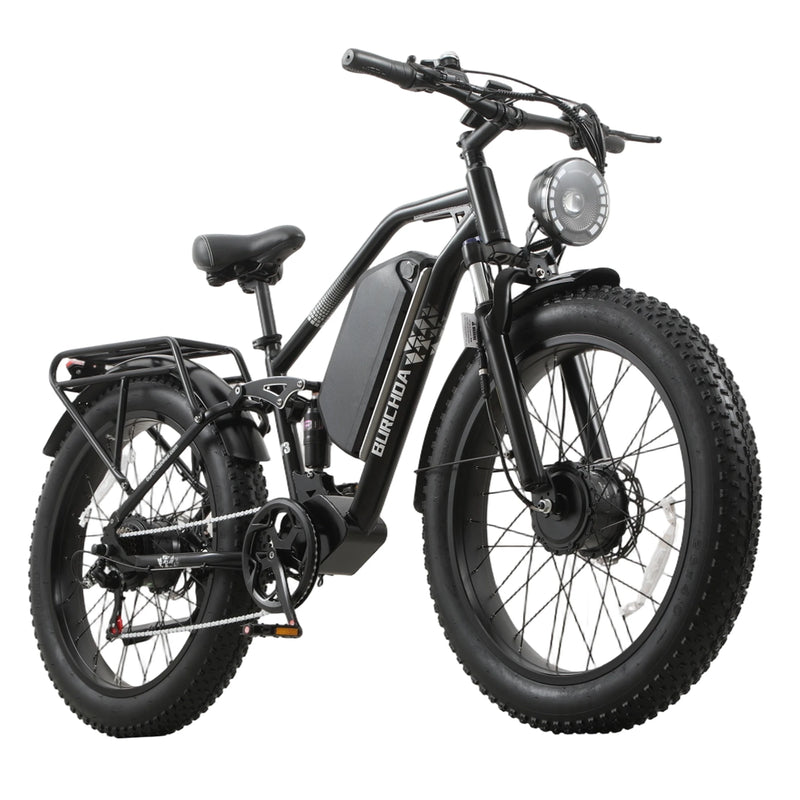
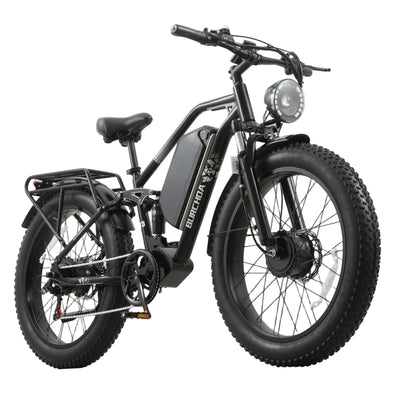
🏆 Burchda Y3 AWD – Best for Heavy-Duty Hauling & Backcountry Power

Why Canadian hunters love it: The Y3 AWD's dual motors (1500W + 1500W rated continuous, 5000W total peak, 210Nm torque) deliver serious climbing power for BC's Rockies and Alberta's foothills. The 227 kg (500 lbs) payload capacity and 130 km (80 mile) range cover 95% of Canadian hunting scenarios.
- Dual Hub Motors, 52V, 1500W + 1500W rated (3000W total), 5000W peak, 210Nm torque
- 52V 30Ah battery (130+ km / 80 mile range, 1560Wh)
- 500 lbs (227 kg) max load, 1000 lbs towing capacity
- 26" × 4.0" fat tires, Carbon Steel frame, 105 lbs
- UL 2849 battery safety certified (safety ≠ legal compliance — see disclaimer)
- User Rating: 4.91 (93 reviews)
Price: $1,999 | Free shipping across Canada, 2-year warranty
🚵 Burchda HC26 AWD – Best Value for Serious Trail Hunting

Why it's perfect: At just $1,999, the HC26 AWD offers real dual motor power with premium specs usually found on bikes costing twice as much. 1000W + 750W rated continuous (1750W total), 3000W peak (150Nm torque) handles Ontario's Bruce Peninsula trails, BC's Gulf Islands backcountry, and Saskatchewan's forest roads with ease.
- Dual Hub Motors, 48V, 1000W + 750W rated (1750W total), 3000W peak, 150Nm torque
- 48V 30Ah battery (130+ km / 80 mile range, IP65 waterproof)
- 500 lbs (227 kg) max load, 1000 lbs towing capacity
- 26" × 4.0" fat tires, Aluminum frame, 95 lbs, 30 MPH top speed
- Front + rear air suspension, SHIMANO 7-speed, hydraulic disc brakes
- UL 2849 battery safety certified (see compliance disclaimer)
- User Rating: 4.91 (172 reviews)
Price: $1,999 | Free shipping across Canada, 2-year warranty
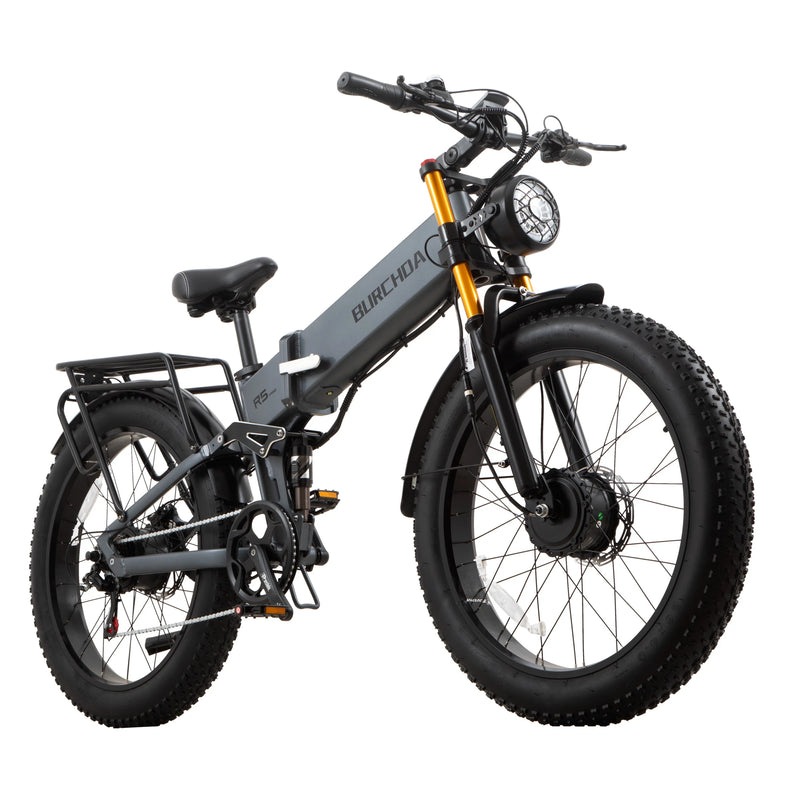
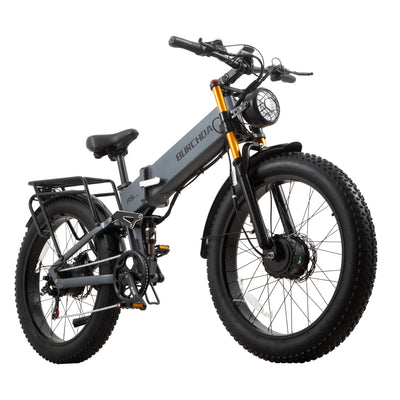
🎒 Burchda R5 AWD – Best Folding AWD for Urban Hunters & Weekend Trips

Why it's great: The 2-step folding frame makes this AWD hunting e-bike easy to store in a Montreal apartment or transport on a Vancouver SeaBus. Unfolds in seconds, delivers 1500W + 1500W rated continuous (3000W total), 5000W peak (230Nm torque) power on the trails.
- Dual Hub Motors, 48V, 1500W + 1500W rated (3000W total), 5000W peak, 230Nm torque
- 48V 30Ah battery (130+ km / 80 mile range, UL certified)
- 550 lbs (249 kg) max load, 1000 lbs towing capacity
- Folding frame (2-step), 95 lbs, 40 MPH top speed, 26" × 4.0" fat tires
- Front + rear suspension, SHIMANO 7-speed, hydraulic disc brakes
- UL 2849 battery safety certified (see compliance disclaimer)
- User Rating: 4.98 (362 reviews) ⭐ Highest rated in lineup
Price: $1,999 / Camo $2,199 | Free shipping, 2-year warranty
Ready to Upgrade Your Hunting Game?
Free shipping across Canada. 2-year warranty on all AWD e-bikes. Extended warranty available for hunting use.
Frequently Asked Questions
Are dual motor e-bikes legal for hunting in Canada?
Class 1 e-bikes (500W max, 32 km/h, pedal-assist) are treated as regular bicycles in all provinces. Burchda AWD models have 1750W–3000W total rated continuous output — well above the 500W PAB public-road limit. They are not designed or certified for public road use and are intended for private property, Crown land forest roads, and off-road hunting areas where power restrictions do not apply. BC hunters must also check MVP regulations — e-bikes are classified as motor vehicles and banned in many hunting zones. Always verify local regulations before riding.
How much can a dual motor e-bike haul for hunting?
The Burchda Y3 AWD handles 227 kg (500 lbs) of combined rider and gear weight — that's more than enough for a quartered whitetail deer, your hunting pack, rifle case, and tree stand. Add a game cart accessory and you can haul even more.
Will my e-bike battery last a full day of hunting?
Burchda AWD models with 48V 30Ah or 52V 30Ah batteries deliver 130+ km (80+ mile) range. Cold weather reduces battery capacity by 20-30%, so plan accordingly for winter hunts. Bring a portable charger or a second battery for multi-day trips.
Can I ride my e-bike on ATV trails in Canada?
Sometimes. ATV trails designated for motorized vehicle use generally prohibit e-bikes. However, many Forest Service roads and multi-use trails allow both. Enforcement varies by province and specific area — always check local land management rules before riding. Remember: Burchda AWD models exceed PAB power limits, so you should be prepared to show your hunting license if questioned.
Final Verdict
For most Canadian hunters, a dual motor electric bike is the smartest purchase you'll make this hunting season. It's quieter than a bow, cheaper than a used ATV, legal in more places, and doesn't require trailer towing through -30°C Saskatchewan winters.
Will it replace your ATV for every scenario? No — extreme mud, 18-inch water crossings, and massive bull elk pack-outs are still ATV territory. But for 7 out of 10 hunting days across Canada, an AWD e-bike gets you closer to game, saves you thousands of dollars, and eliminates most of the hassle associated with motorized hunting vehicles.
This is the year to make the switch. Order your Burchda AWD hunting e-bike today and be ready for opening day.

Disclaimer: E-bike regulations in Canada are complex, vary by province, and change frequently. Motor power ratings on e-bikes often state peak (not continuous) power, which is the critical figure for Transport Canada PAB compliance. This article references official sources including Transport Canada Motor Vehicle Safety Regulations (SOR/2000-180), BC Wildlife Act Motor Vehicle Prohibition Regulation (B.C. Reg. 18/2024), Alberta Traffic Safety Act (RSA 2000, c T-6), Ontario Regulation 369/09, and Parks Canada cycling policies — all current as of September 2026, but subject to change. Always carry a current copy of the relevant provincial hunting regulations and contact your provincial ministry of natural resources or park authority for the most current rules before riding on Crown land, provincial parks, or protected areas. BC hunters: always check the official BC MVP maps before hunting — e-bikes are classified as motor vehicles and banned in many MVP zones. Prices shown are in CAD and include free shipping across Canada. Burchda Canada recommends all riders verify local e-bike regulations and consider optional e-bike insurance regardless of motor power.