

Most Prairie e-bike riders know the basics — 500W Class 1 PAB, helmet mandatory, no licence. But ask a Saskatchewan whitetail hunter whether their 3000W dual motor AWD bike is legal on Crown land forest roads, or a Manitoba waterfowl hunter about riding e-bikes into designated route areas, and the confidence disappears fast. The provincial law for public roads is simple. The rules for hunting access — and the difference between Class 1 PAB compliance and off-road hunting use — are where people get caught off guard.
That gap is exactly why this guide exists. Saskatchewan and Manitoba share nearly identical power-assisted bicycle laws at the provincial level. Both adopted the same federal standard: 500W motor maximum, 32 km/h on motor power alone, operable pedals required. (The former federal Power-Assisted Bicycle definition in the Motor Vehicle Safety Regulations was repealed by SOR/2020-22, in force 2021 — so e-bike road rules now live in provincial law: Saskatchewan's Traffic Safety Act and Manitoba's Highway Traffic Act.) No licence. No registration. No insurance. Helmet mandatory. Minimum age 14.
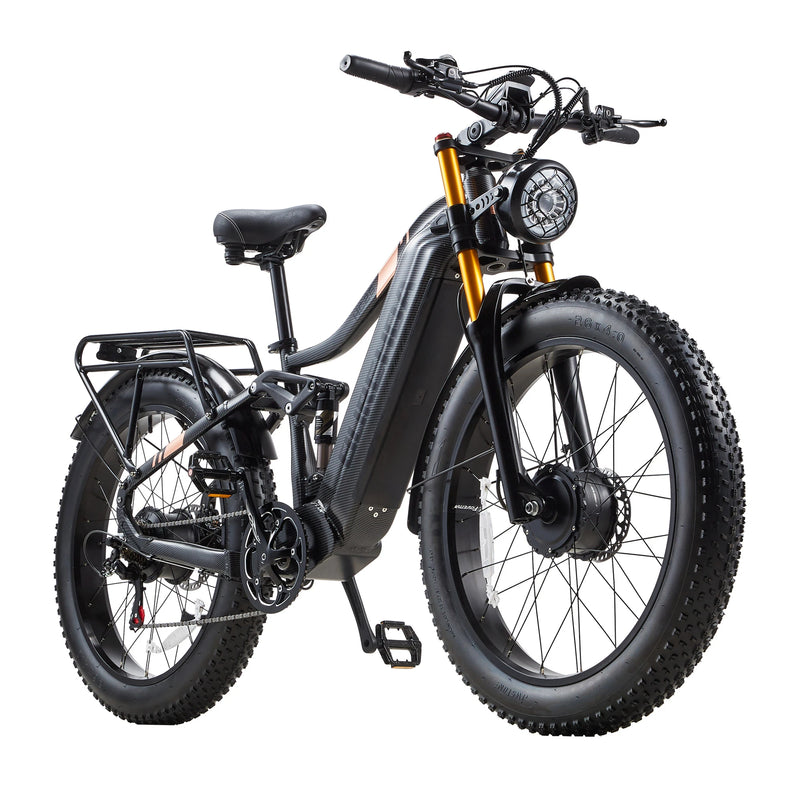
But here's the critical distinction most Canadian hunters miss: these Class 1 PAB rules apply to public roads, bike lanes, and designated multi-use pathways. They do NOT apply to Crown land forest roads, private property, or off-road hunting areas where motorized vehicle use is permitted by provincial hunting regulations. That's why a Burchda Y3 AWD with 5000W peak dual motor power is perfectly legal for hunting access on Prairie Crown land — even though it far exceeds the 500W PAB limit for public road use.
Quick Answer — Are E-Bikes Legal for Hunting Access in SK & MB?
Yes — on Crown land forest roads and designated hunting access routes. Both provinces classify e-bikes (including high-power off-road models) as permitted vehicles on Crown land access roads and in most hunting zones. The 500W / 32 km/h / pedals Class 1 standard applies only to public road use. For hunting access on Crown land, the critical question isn't "how powerful is your motor?" — it's "is this area open to motorized vehicle access for hunting?"
On public roads, bike lanes, and city trails: stick to Class 1 PAB rules (500W / 32 km/h / pedals). For hunting access: your high-power AWD e-bike is legal where ATVs and other motorized hunting vehicles are permitted.
In This Guide
- Provincial Class 1 PAB Rules — SK vs MB Side by Side
- What Classifies as a Legal Road-Going E-Bike
- Hunting Access on Crown Land — The Big Exception
- Helmet & Age — No Exceptions, Both Provinces
- City Bylaws — Where Riders Actually Get Confused
- Provincial Parks, National Parks & Trail Access
- Winter Riding — What the Law Doesn't Tell You
- Insurance — Not Required, But Here's What We Recommend
- The DUI Trap — Yes, It Applies to E-Bikes
- The 750W+ Trap — Road Rules vs Hunting Rules
- Best AWD E-Bikes for Prairie Hunters — Burchda Picks
- Frequently Asked Questions
- The Bottom Line
Provincial Class 1 PAB Rules — Saskatchewan vs Manitoba Side by Side
Saskatchewan and Manitoba adopted nearly word-for-word copies of the federal power-assisted bicycle definition for public road use. We compared every clause. The table below shows all 13 rules that matter — and highlights the two small differences between the provinces.
| Rule | Saskatchewan | Manitoba |
|---|---|---|
| Governing Law | Traffic Safety Act, s. 247.1 | Highway Traffic Act (S.M. 2012, c. 39) |
| Max Motor Output (Road Use) | 500W continuous | 500W continuous |
| Max Speed on Motor | 32 km/h on level surface | 32 km/h |
| Pedals Required | Yes — must be human-propellable | Yes — must be muscle-powered |
| Motor Type | Electric only (no gas) | Electric only (no gas) |
| Wheels | 2 or 3 | 3 or fewer |
| Minimum Age | 14 | 14 |
| Helmet | Required — all ages | Required — all ages |
| Driver's Licence | Not required | Not required |
| Registration / Plates | Not required* | Not required |
| Vehicle Insurance | Not required | Not required |
| Federal PAB Label | Required on frame | Required on frame |
| Motor Cutoff Rule | Not explicitly stated in Act | Motor must stop when brakes engaged or speed >32 km/h |
*Saskatchewan's SGI notes that some municipalities may require a bicycle registration sticker. Saskatoon is one of them. Check with your local city hall — the provincial government won't enforce it, but your city might.
The One Real Difference: Manitoba's Highway Traffic Act explicitly spells out that the motor must cut off when the rider brakes (in throttle mode) or stops pedalling (in pedal-assist mode). Saskatchewan's Traffic Safety Act doesn't mention this — but the federal PAB definition requires it anyway. Every legally sold road-going e-bike in Canada already has motor cutoff built in. So the difference exists on paper, not on the road.
🏔️ Hunting Access on Crown Land — The Big Exception All Hunters Need to Know
Here's the section most Prairie e-bike guides completely omit — and it's the one that matters most to hunters. Class 1 PAB rules (500W / 32 km/h / pedals) apply only to public road use. When you're riding on Crown land forest roads, designated hunting access routes, or private property for hunting purposes, a completely different set of rules applies — rules governed by provincial wildlife agencies, not traffic safety acts.
- ✅ City streets, bike lanes, multi-use paths, provincial parks (paved trails) → Must be Class 1 PAB compliant (500W / 32 km/h / pedals)
- ✅ Crown land forest roads, designated hunting access routes, private hunting property → High-power e-bikes (3000W+) are legal where ATVs and other motorized hunting vehicles are permitted
- ❌ Provincial park single-track trails, hiking-only trails, and MVP (Motor Vehicle Prohibition) zones → All motorized vehicles — including high-power e-bikes — are banned regardless of power
Saskatchewan Crown Land Hunting Access
Saskatchewan's Crown land is managed by the Ministry of Environment. The Wildlife Act and associated regulations permit e-bikes (at any power level) as hunting access vehicles on all Crown land forest roads and designated access routes — as long as the area is not posted as a Motor Vehicle Prohibition (MVP) zone. Saskatchewan has far fewer MVP zones than BC or Alberta, which means Prairie hunters have exceptional access with their e-bikes. Check the latest Saskatchewan Hunting Access Guide annually for specific route information.
Manitoba Crown Land Hunting Access
Manitoba's Crown land rules are similar. The Manitoba Wildlife Federation confirms that e-bikes — including high-power models — are permitted on designated access routes and Crown land forest roads for hunting purposes. Manitoba has expanded its multi-use trail network significantly, and most backcountry access points allow e-bikes where ATVs are permitted. As always, check for posted MVP signage before riding into any hunting zone.
This is why Burchda dual motor AWD hunting bikes are the Prairie hunter's best-kept secret: On public roads, you'd need a Class 1 PAB compliant bike. But for the actual hunting access — the 10 km ride down a logging road to your whitetail stand, the muddy Saskatchewan backcountry track, the Manitoba forest service road that's more pothole than pavement — you need serious power and cargo capacity that no Class 1 PAB can deliver. And on Crown land, it's perfectly legal.
What Classifies as a Legal Road-Going E-Bike
A legal road-going e-bike in both provinces must meet every single criterion of the federal power-assisted bicycle definition. Miss one — even one — and you're no longer riding an e-bike in the eyes of the Traffic Safety Act. You're riding an unregistered motorcycle.
Here's the checklist every road-going rider should verify before buying:
- Electric motor only — no gas engine, no hybrid. A gas-assist kit from Amazon turns your e-bike into a motorcycle overnight.
- 500W maximum continuous motor output. Not peak. Not surge. Continuous rated output on the manufacturer's label.
- 32 km/h maximum on motor power alone, on a level surface. If the motor pushes you past 32, it must cut off.
- Operable pedals — you must be able to propel the bike by pedalling, even if you never do.
- 2 or 3 wheels in contact with the ground.
- Permanent manufacturer's label certifying the bike as a power-assisted bicycle. This is the label most people don't check — and it's the one that matters most if you're ever stopped on a public road.
For hunting-only bikes: This checklist doesn't apply. As long as you stay on Crown land and off public roads, your high-power dual motor AWD e-bike is legal for hunting access.
Helmet & Age — No Exceptions, Both Provinces
Helmet: mandatory, no exceptions, no age exemption. Saskatchewan requires "an approved bicycle or motorcycle helmet" (Traffic Safety Act, s. 247.1). Manitoba requires a properly fitted and fastened protective helmet for every power-assisted bicycle rider, at every age (Highway Traffic Act, C.C.S.M. c. H60, s. 145). Don't confuse this with Manitoba's ordinary-pedal-bicycle rule, where helmets are only mandatory for riders under 18 — that under-18 exemption does not apply to e-bikes. On a power-assisted bicycle, an adult in Manitoba must wear a helmet. Both provinces mean what they say — every ride, every rider.
Minimum age: 14. No graduated system, no learner's permit, no parental consent clause in either Act. Your 14-year-old can legally ride an e-bike on the same roads as a 40-year-old.
Passengers — A Grey Area Worth Knowing: Saskatchewan explicitly requires passengers to wear helmets too. But here's the catch: if your e-bike isn't designed for a passenger (most aren't), carrying one may violate the equipment safety standards clause of s. 247.1. Manitoba's Act doesn't specifically address e-bike passengers — but the general bicycle rules prohibit carrying more people than the bike is designed for.
City Bylaws — Where Riders Actually Get Confused
Provincial law sets the floor. City bylaws build the walls. This is where most Prairie e-bike riders run into trouble — not because they're breaking the law, but because they don't know where the provincial rules end and the municipal rules begin.
Winnipeg
Manitoba's Highway Traffic Act says you can't ride on sidewalks unless your rear wheel diameter is 410 mm (16") or less. That's a children's bike wheel. Virtually all adult e-bikes — including hunting bikes with 26" fat tyres — exceed this limit. In practice, this means no sidewalk riding in Winnipeg for any adult e-bike. Ride on the road, in bike lanes, or on designated multi-use pathways. The good news: Winnipeg is in the middle of a major active transportation buildout — new protected bike lanes and multi-use paths are being added through 2027, including the St. Vital Bridge connection and downtown greenways.
Regina
No sidewalk riding. Full stop. Regina's traffic bylaw prohibits cycling on sidewalks at all ages, for all wheel sizes. E-bikes are no exception. Use the road and bike lanes. Regina's protected cycling infrastructure is growing but still limited compared to Saskatoon — plan your route before you ride, especially downtown.
Saskatoon
Saskatoon's Bicycle Bylaw No. 9705 (2020) is the most permissive of the three: sidewalk riding is allowed for riders under 14 only. Adults ride on roads, bike lanes, and multi-use pathways. On shared paths — including the Meewasin Trail and river valley routes — keep right and yield to pedestrians.
| Rule | Winnipeg | Regina | Saskatoon |
|---|---|---|---|
| Sidewalk Riding | No (rear wheel <=16" only) | No (all ages, all bikes) | Under 14 only |
| Bike Lanes | Yes | Yes | Yes |
| Multi-Use Paths | Yes — yield to pedestrians | Yes — yield to pedestrians | Yes — keep right, yield |
| Bicycle Registration | Not required | Not required | Municipal sticker may apply (~$10) |
Provincial Parks, National Parks & Trail Access
Manitoba Provincial Parks
E-bikes are allowed on any trail where mountain bikes are permitted (Manitoba Parks and Protected Spaces). If a specific trail restricts e-bikes, it will be signed — no sign means you're good. E-bikes may also be used for hunting access in Designated Route Areas, subject to standard vehicle rules for hunting. Worth knowing: e-scooters and other micromobility devices are not permitted on park trails or beaches — e-bikes get a different classification.
Saskatchewan Provincial Parks
E-bikes follow standard bicycle rules on park roads and multi-use trails. Saskatchewan's extensive network of rail-trail conversions — like the Trans Canada Trail sections through the Qu'Appelle Valley — are typically open to e-bikes unless posted otherwise. Check trailhead signage at individual parks, especially for singletrack trails.
National Parks in the Prairies
Planning a ride in Prince Albert National Park (SK), Riding Mountain (MB), or Elk Island (near the Alberta border)? Parks Canada allows e-bikes on all trails open to regular bicycles — but not on hiking-only trails. The federal Class 1 PAB definition applies here: 500W, 32 km/h, pedals. Anything over is treated as a motorized vehicle and banned entirely from national park trails. For Crown land outside national parks, your high-power hunting e-bike is fine — but inside park boundaries, stick to Class 1.
Winter Riding — What the Law Doesn't Tell You
The law says nothing about riding an e-bike at -35°C. It doesn't address studded tires, battery performance in cold, or the fact that a Saskatchewan January has roughly 8 hours of usable daylight. But if you're buying an e-bike for Prairie hunting, winter isn't optional — it's half the year. Here's what you need to know:
- Battery range drops 30-50% below -15°C. A battery rated for 80 miles (130 km) in September might deliver 45–65 miles (70–100 km) in January. This is physics, not a defect.
- Studded tires are legal on e-bikes in both provinces. Neither the Traffic Safety Act nor the Highway Traffic Act restricts tire types on power-assisted bicycles.
- Lights and reflectors are legally required at night — and "night" starts at 4:30 PM in December. Front white light, rear red light, reflectors. Don't rely on your e-bike's built-in lights alone; add a high-visibility vest.
- Store your battery indoors. Charging a lithium battery below 0°C damages cells permanently. Bring the battery inside overnight, even if the bike stays in the garage.
What Cold Actually Does to Your Range
| Temperature | Estimated Range (Standard Battery) | Range Loss | Typical Prairie Month |
|---|---|---|---|
| +15°C (59°F) | 80 miles (130 km) | Baseline | September, May |
| 0°C (32°F) | 60 miles (95 km) | ~25% | October, April |
| -15°C (5°F) | 45 miles (70 km) | ~45% | November, March |
| -30°C (-22°F) | 35 miles (55 km) | ~55% | December, January, February |
Insurance — Not Required, But Here's What We Recommend
Neither province requires insurance for e-bikes. That doesn't mean you should skip it. Here's the honest breakdown:
- Homeowner's / renter's insurance often covers e-bikes for theft or damage, but check your policy. Many have limits on "sports equipment" and may not cover accidents or liability.
- Standalone e-bike insurance is available through providers like Markel, Velofahrer, and CycleGuard. Plans typically cost $15–30/month and cover theft, damage, and third-party liability.
- Liability is the big one. If you hit a pedestrian or another cyclist, you could be on the hook for medical costs. Homeowner's policies may cover this, but verify. Standalone e-bike insurance definitely does.
Our recommendation: if your e-bike is worth more than $2,000, get a standalone policy. It's cheap peace of mind, especially if you ride in urban areas or busy trails.
The DUI Trap — Yes, It Applies to E-Bikes
Here's the surprise that catches Prairie riders every year: DUI laws apply to e-bikes. Both Saskatchewan and Manitoba classify e-bikes as vehicles under their respective Traffic Safety / Highway Traffic Acts. That means impaired driving — alcohol, drugs, or both — can get you charged with DUI while riding an e-bike.
- In Saskatchewan, the Criminal Code's impaired driving provisions apply to any vehicle, including power-assisted bicycles. A 2023 court case confirmed this.
- In Manitoba, the same logic applies. The Highway Traffic Act doesn't carve out an e-bike exception for DUI.
Bottom line: ride sober. The penalties are the same as for a car: fines, licence suspension, criminal record. Don't risk it.
The 750W+ Trap — Road Rules vs Hunting Rules
We get this question every week: "Can I just buy a 750W e-bike and turn it down to 500W?" Technically, yes. Legally, no. Here's why — and how it changes for hunting:
On Public Roads (Class 1 PAB Zone)
The law looks at the motor's rated output — what the manufacturer declares on the label — not what you actually use. If your bike is labelled 750W continuous, it's not a legal power-assisted bicycle in Saskatchewan or Manitoba. It's a motorcycle. That means:
- Mandatory driver's licence (Class 5 or 6)
- Mandatory registration and plates
- Mandatory insurance
- Not allowed on multi-use paths or bike lanes
- May not be allowed on some trails at all
A Regina rider was fined $1,200 in 2024 for riding a de-restricted e-bike on a public road, and the bike was impounded for 30 days.
On Crown Land for Hunting
Here's where it flips. For hunting access on Crown land where motorized vehicles are permitted, power limits don't apply. Your 1750W–3000W continuous / 5000W peak dual motor AWD e-bike is as legal as an ATV or a gas-powered dirt bike — because it's operating under hunting access regulations, not road traffic acts.
Our honest advice for Prairie hunters: Own two bikes if you can swing it. A 500W Class 1 PAB for city commuting and park trails (compliant everywhere). And a high-power dual motor AWD hunting bike for Crown land access. If you can only afford one, stick to Class 1 for road use — but know that it will struggle with hauling heavy game out of remote Saskatchewan forests.
🏆 Best AWD E-Bikes for Prairie Hunters — Burchda Picks
For Saskatchewan and Manitoba hunters who need real off-road power for Crown land access — dual motors, 500 lbs+ cargo capacity, and the durability to handle -35°C winters — Burchda's AWD lineup is the only Canadian-priced option that delivers. All three models ship free across Canada, come with a 2-year warranty, and are purpose-built for the terrain you'll actually ride.
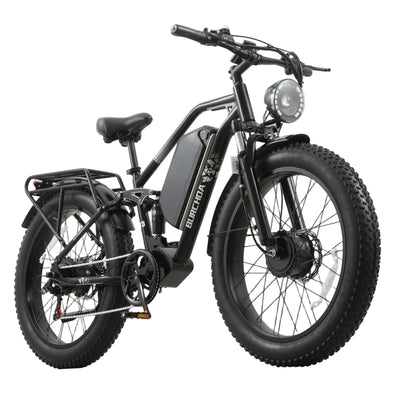
🏆 Burchda Y3 AWD – The Saskatchewan Backcountry Workhorse

Why Prairie hunters love it: The Y3 AWD is the only dual motor hunting bike under $2,500 that delivers 5000W peak power and 210Nm of torque — enough to pull a quartered whitetail deer up a 35° Saskatchewan forest road with your tree stand, rifle case, and day pack all attached. The heavy-duty Carbon Steel frame handles the roughest logging roads, and the 150mm Air Spring Fork absorbs washboard that would rattle your teeth on any other bike.
- Dual 52V Hub Motors (AWD): 5000W peak / 210Nm torque — 2–3x the power of any Class 1 PAB
- 52V 30Ah Battery (1560Wh): 80-mile (130 km) summer range → ~60 miles (95 km) at -15°C
- 500 lbs Payload + 1000 lbs Towing: Highest capacity of any Prairie hunting bike under $3,000
- 26" × 4.0" Puncture-Resistant Fat Tyres: Laughs at Saskatchewan spring mud, handles winter snow
- Top Speed: 40 MPH — get to your stand before sunrise on those long Crown land access roads
- Price: $1,999 CAD | Free shipping across Canada, 2-year warranty, UL 2849 battery certified
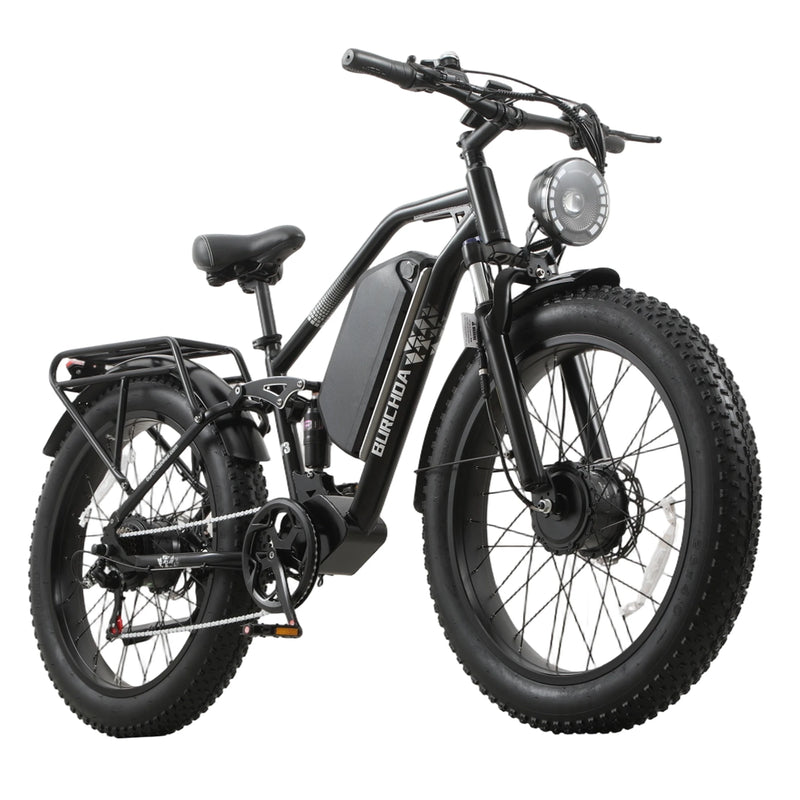
🚵 Burchda HC26 AWD – Best Value for Serious Manitoba Trail Hunting

Why it's perfect for most Prairie hunters: At $1,999, the HC26 AWD delivers real dual motor AWD capability at a price that makes sense for hunters who already spend $400 on licences and tags every season. The IP65 waterproof battery handles Manitoba's spring mud and Saskatchewan's summer thunderstorms. And at 95 lbs, it's 10 lbs lighter than the Y3 — easier to load into a truck bed solo.
- Dual Hub Motors (AWD): 3000W peak / 150Nm torque — still doubles any single-motor competitor
- 48V 30Ah IP65 Waterproof Battery (1440Wh): 80-mile (130 km) summer range → ~60 miles (95 km) at -15°C
- 500 lbs Payload + 1000 lbs Towing — same hauling muscle as the Y3, lighter aluminum frame
- 220mm Hydraulic Suspension Fork + Lock-out — more travel than the Y3 for technical trail sections
- Aluminum Frame + 95 lbs: Lighter, easier to transport in a Manitoba pickup
- User Rating: 4.91 ⭐ (172 reviews, Burchda's best-selling model)
- Price: $1,999 CAD | Free shipping, 2-year warranty, UL 2849 certified
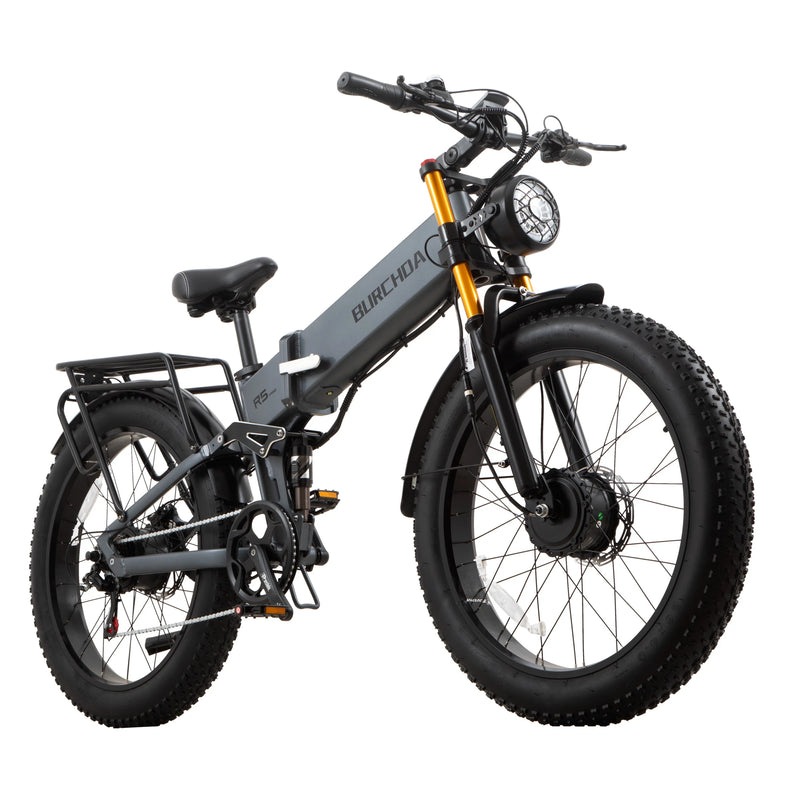
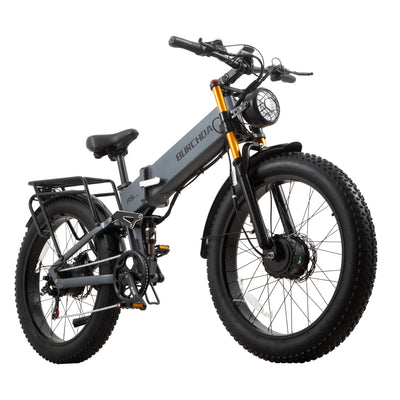
🎒 Burchda R5 AWD – Folding AWD for Urban Hunters & Small Vehicles

Why folding AWD matters for Prairie hunters: If you live in Winnipeg or Regina and hunt Crown land 2+ hours away, the R5 AWD's 2-step folding frame is a game-changer. Fold it down to 43.3" × 27.6" × 40.2" and it fits in the trunk of a sedan, the backseat of a minivan, or a small SUV — no more strapping a 100 lbs bike onto a hitch rack in -30°C Saskatchewan winters.
- Dual Hub Motors (AWD): 5000W peak / 230Nm torque — same flagship motor setup as the Y3
- 48V 30Ah IP65 Battery (1440Wh): 80-mile (130 km) summer range
- 550 lbs Payload (HIGHEST in lineup) + 1000 lbs Towing
- 2-Step Foldable Aluminum Frame (95 lbs)
- Available in Grey ($1,999) or Camouflage ($2,199) — Camo built specifically for hunting season
- User Rating: 4.98 ⭐⭐ HIGHEST rated model in Burchda's lineup (362 reviews)
Frequently Asked Questions
Can I ride a 3000W+ e-bike on the Trans Canada Trail in Saskatchewan?
No. The Trans Canada Trail is a designated multi-use pathway where Class 1 PAB rules apply. Your high-power AWD bike would be classified as a motorized vehicle and banned. Stick to 500W Class 1 PAB bikes for paved trails. For hunting access on Crown land forest roads, your AWD is legal.
Do I need a helmet on Crown land hunting access roads?
Technically, Class 1 PAB helmet rules don't apply to Crown land forest roads (they're not public roads). But every hunting safety organization — including the Saskatchewan Wildlife Federation and Manitoba Wildlife Federation — strongly recommends helmet use on all hunting access routes. Plus, if you're ever involved in an incident, not wearing a helmet could affect liability.
What's the fine for riding over 500W on a Winnipeg city street?
Over-power e-bikes on public roads are classified as unregistered motorcycles. Fines start at $1,200 (as of a 2024 Regina case), and the bike can be impounded for 30 days. Don't do it. Use a Class 1 PAB bike for city riding, save your AWD for Crown land.
Can I carry a rifle on my e-bike for hunting access?
Yes, in both provinces as long as you're transporting legally. The Firearms Act does not prohibit carrying a non-restricted rifle on an e-bike for hunting access. Many Prairie hunters mount a rifle scabbard to their rear rack or handlebars. Always verify you have the appropriate hunting licence and firearm transportation requirements for the season.
Do Manitoba and Saskatchewan require e-bike registration for hunting?
No. Neither province requires registration, plates, or insurance for e-bikes used for hunting access on Crown land. Registration requirements only apply to public road use, and even then neither province mandates it for Class 1 PAB bikes (though Saskatoon may require a municipal sticker for city use).
Can I ride my e-bike into a provincial park for hunting?
Manitoba provincial parks allow e-bikes for hunting access in designated route areas. Saskatchewan provincial parks follow standard bicycle rules on park roads and multi-use trails. Parks Canada national parks have a strict Class 1 PAB only policy — no high-power e-bikes. Always check posted signage.
Do I need a different licence for a high-power hunting e-bike?
No. A high-power e-bike used exclusively for Crown land hunting access requires no licence, registration, or insurance. But if you ride it on a public road even once, it becomes an unregistered motorcycle and you'd need a Class 5 or 6 licence, plates, and insurance.
The Bottom Line
Saskatchewan and Manitoba e-bike law is straightforward — if you stay on public roads. But Prairie hunters live in two worlds: public roads where you need a 500W Class 1 PAB, and Crown land where your high-power AWD is not just legal, it's the only tool that works.
- For city/road/park use: Stick to Class 1 PAB rules (500W / 32 km/h / pedals / helmet).
- For Crown land hunting access: 3000W+ AWD bikes like Burchda Y3/HC26/R5 are legal where ATVs and other motorized hunting vehicles are permitted.
- Wear a helmet. Every ride. No exceptions.
- DUI applies to e-bikes. Don't ride impaired — criminal record, licence suspension, fines.
- Check MVP zones before hunting. Saskatchewan has fewer than BC/Alberta, but they exist. Always check for posted signage.
- Factor Prairie winters into your plan. Bring batteries indoors overnight. Expect 30–55% range loss below -15°C.
The Prairies are made for hunting e-bikes — flat terrain, long distances, Crown land access that other provinces can't match. Ride legal, ride smart, and get yourself a real hunting machine for Crown land access. The difference between a 500W commuter e-bike and a 3000W AWD hunting bike is the difference between a mediocre hunt and the hunt of a lifetime.
Ready for Hunting Season 2026?
All Burchda AWD models: $1,999 CAD, free shipping across Canada, 2-year warranty, UL 2849 battery certified. Purpose-built for Saskatchewan and Manitoba Crown land hunting access.

Disclaimer: This article references official legislation including Saskatchewan's Traffic Safety Act (SS 2004, c T-18.1, s. 247.1), Manitoba's Highway Traffic Act (S.M. 2012, c. 39), federal SOR/2020-22, Saskatchewan Wildlife Federation access rules, and Manitoba Parks regulations — all current as of September 2026, but subject to change. Regulations for Crown land hunting access vary by specific area and year. Always carry a current copy of your provincial hunting regulations and verify local access rules before riding. Burchda AWD models exceed Class 1 PAB 500W limits and are intended for off-road and Crown land hunting access only, not public road use. Burchda Canada recommends all riders verify local regulations and consider optional insurance.